
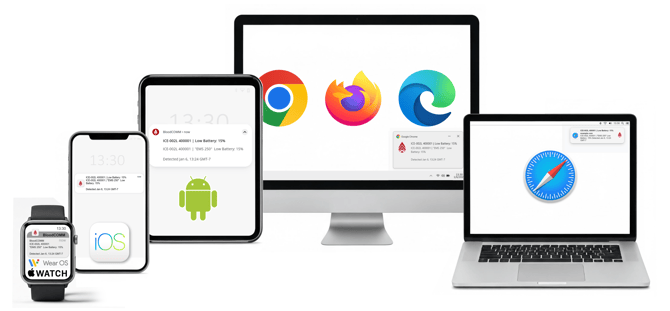
BloodCOMM Alerts are secondary alerts to the hardware device's primary alarms. BloodCOMM is only able to send alerts based on available network connections and user preferences.
All blood storage devices should be continoiusly monitored in-person to identify audio and visual alarms.
Alerts in BloodCOMM
Alerts are automatic notifications which are sent to your phone, computer, email, and more when a device detects an issue. Alerts are sent when the device detects an issue, such as a temperature excursion, low battery, or other issue. You can customize the alerts you receive, and how you receive them, in the Alerts section of the app.
BloodCOMM Cloud continuously monitors the status of all connected devices, and will send alerts when an issue is detected. The following must be true for an alert to be able to be sent:
- The device must be connected to the internet (via cell network or BloodCOMM Connect).
- The device must report the issue to the BloodCOMM Cloud.
- ICE-2Ls and BloodCOMM Connect devices report their status every 15 minutes.
- The device must have an active BloodCOMM License.
- Your user account must have alerts enabled.
- You must be subscribed to alerts for the device via per-user settings or organization-wide settings.
Organization Alerts & User Alerts
BloodCOMM allows Organizations to set alerts on behalf of users. This allows administrators to apply global alert settings to the entire organization, and ensures that every user receives alerts at the correct thresholds. Organizational alert overrides cannot be disabled by individual users, and will send as long as the alerting method (email, SMS, etc.) has been set up. If a user disables alerts completely they will not receive Organization alerts. Read more about Organizational Overrides.
In addition, all users are able to create and set up their own Alerts. this enables users to receive alerts before Organization alerts are triggered, or to receive additional alerts if desired. Users are able to see both their alerts and Organization-level alerts in their Settings.
Organization and User Alerts are deduplicated prior to sending out, meaning that duplicate alerts will not be sent if both have been configured to the same setting.
Email Alerts:
SMS (Text Message) Alerts:
Push Notification (Android, iOS, & Web) Alerts:
Phones and web browsers which are managed by employer IT departments may not be able to receive push notifications. Please check with your IT department if you are unable to activate push notifications due to blocked permissions.
Types of Alerts:
Threshold Alerts
Threshold alerts are alerts which are triggered when the value crosses the specified threshold. For example, if a threshold is set at 5.6°C, and the device increases from 5.5°C→ 5.8°C,the threshold has been crossed, and the alert will trigger.
Device-Specific alerts are only available to users within the assigned organization, and will not function for Remote Access organizations.
The currently available Threshold Alerts are:
- Device Temperature
The temperature of a device has crossed the relevant threshold. Used for Temperature Warnings and Excursion alerts. Note: For temperatures less than 4.0°C, the value must be decreasing, for temperatures greater than 4.0°C the value must be increasing. - Time Until Excursion
Also known as "Duration" or "Holdover", this value is the remaining time until an excursion is estimated to happen, based on internal device sensors and calculations. As this value takes into account multiple temperature sensors, battery life, and ambient conditions, it is recommended to use this over a simple temperature threshold to prevent excursions. - Low Battery
The battery of the device has crossed below the specified threshold. Note that the minimum value is 20% as the devices may enter power saving state or otherwise be unable to communicate with the BloodCOMM cloud with low battery. - Device Offline
The device has not connected to the BloodCOMM Cloud for more than the specified number of hours. It is recommended to set this value to a minimum of 8 hours, as all Delta Development devices have on-board storage, and cellular service may be unreliable in certain situations.
Note that Threshold alerts are sent only after the threshold has been crossed. This means that the default excursion settings will trigger when the device reaches 6.1°C or 1.9°C.
Excursions in BloodCOMM are an indicator that an Excursion has already happened, not that an Excursion is impending.
Toggled Alerts
Toggled alerts are triggered based on specific actions or events within BloodCOMM. For example, if a Blood Bag is marked as Transfused, then the alert will be sent out.
The currently available Toggled Alerts are:
- Blood Excursion

If any device which is actively carrying blood detects a temperature excursion, the alert is triggered. Alerts will list the individual blood bags which experienced the excursion temperature.
Note: Enabling this alert will cause duplicate "Excursion" alerts if device-specific temperature alerts are also enabled. - Blood Transfusion
When a "Transfusion" event is submitted, changing the status of a Blood bag to "Transfused" this alert will trigger.